Quantitatively Assessing Architectural Aesthetic Character: A New ‘Intelligent’ Approach for Australia’s Designers, Councils and Courts.
Descriptions of architectural aesthetic character are currently used by: (i) building assessors to make decisions about contextual fit; (ii) architects to describe new designs that are proposed for approval; (iii) heritage planners drafting legislation for conservation areas; and (iv) design researchers to classify and understand the built environment. As such, architectural aesthetic character is one of the very few factors that is equally pivotal to supporting the administrative and legal approval process for new buildings, the economic viability of projects and advances in the intellectual culture of architecture (Salvan 2005; Farrelly 2007).
Despite its significance, aesthetic character is one of the last major architectural concepts that is qualitatively understood and it is, in legal terms, innately subjective, as it is neither ‘repeatable’ nor ‘generalizable’ (Sheahan 2000; Sweet and Schneier 2009). In order to respond to the need for quantitative aesthetic assessment techniques for architecture, four substantial knowledge gaps must be addressed.
In response to this growing national and international problem, this Discovery Project aims to:
- develop new empirical knowledge about the ways architectural aesthetic character is assessed.
- investigate the capacity of advanced computational methods to differentiate architectural aesthetic character.
- develop a world-first objective, repeatable and ‘intelligent’ technique for supporting administrative and legal
determinations of architectural aesthetic fit. - apply this intelligent aesthetic assessment technique (i-AAT) to selected real-world cases, demonstrating itspotential practical value across Australia’s design sector, councils and environment courts.
Through these four aims, this project seeks to develop the knowledge and tools required for a world-first technique for the quantitative assessment of architectural aesthetics in accordance with administrative and legal expectations.
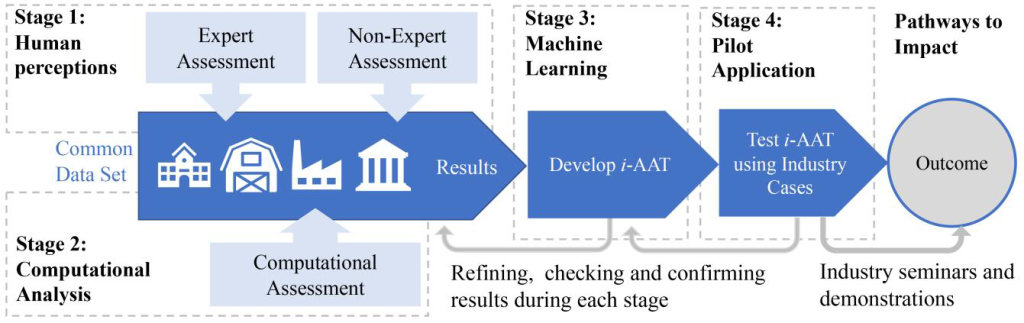
Research stages
The majority of Australians inhabit urban environments every day; living and working in, and being surrounded by, buildings. Architecture is amongst the most enduring and important representations of our social and cultural values, offering a clear expression of the way we shaped our past and aspire to present ourselves to the world. The external visual appearance of a building is its most tangible expression, which is why the history and theory of architecture have been repeatedly framed around interpretations of aesthetic character. In this context, the present project proposes a ground-breaking opportunity to develop new insights into the way we understand architectural aesthetics.
While style and expert opinion will remain an important part of research in architectural history and theory, this project offers a powerful supplementary tool for scholars to analyse historic regions, social and cultural patterns and also the evolving character of an individual architect’s works. When combined with traditional architectural historical and philosophical scholarship, the i-AAT developed through this research will open up new and exciting ways of interpreting the history and theory of the built environment. These will also be significant for cognate fields including engineering, heritage
conservation, urban design, industrial design and art history, all of which use aesthetic assessment and often in association with formal classification or approval systems.
DP220101598