Designing Across Cultures and Spaces: Architecture, Technology and Language in Multilingual Teams.
Diverse Designing. Boosting services exports after the pandemic needs a shared cultural background and language skills (Aus. Gov. 2021b). In addition, architectural practices are increasingly reliant on work channelled through their international workforces, particularly in the Asia–Pacific (APAC) region, and multilingual partners (Architects Accreditation Council of Australia, AACA 2018).
Online Designing. During the pandemic, 90% of Australian firms use online collaboration tools (Infra. Aus. 2021). As such, architectural practices have rapidly adopted virtual team technologies such as video-conferencing, Virtual Reality (VR) and Building Information Modelling (BIM). This situation, often occurring in parallel with the pressures of ‘working from home’ (WFH), is expected to continue for the new normal (ibid. 2021).
Challenges. This combination of designing on-line and in diverse teams poses three important problems for architects: (i) increasing internationalisation of architectural practice exposes the current limits in capacity to design in culturally and linguistically diverse teams, (ii) complete reliance on digital technologies for design collaboration requires new ways of interacting and (iii) new types of design communication are required to support the combination of online and diverse team processes.

In response to this growing national and international problem, the overarching aim of this Discovery Project is to: understand and reduce the significant barriers to efficient and sustainable interactions between architects in spatially and culturally diverse teams. The three specific research aims which collectively serve this larger agenda are to:
- Develop new knowledge about effective online, multilingual design teams, and the digital technologies and communication methods they require;
- Identify the critical cognitive, social and technical success factors for online design collaboration;
- Develop a resource guide for supporting effective teamwork in online, multilingual design teams.
Collectively these three aims support the development of innovative knowledge and resource guide, to create better architectural design outcomes.
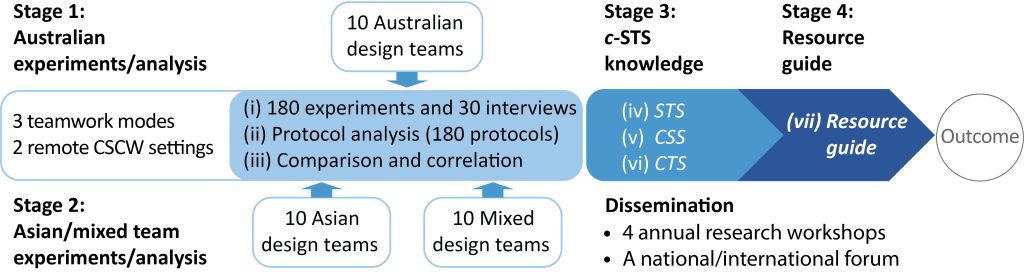
Research stages

This research will contribute to fundamental knowledge building about the ways different cultures understand and communicate their design values and activities using technology, thereby advancing a new interdisciplinary field of research. Specifically, the new c-STS model and methodological approaches proposed in this project will provide a ground-breaking methodological contribution to research in the fields of architectural cognition and computing. Although the collected research data will be sourced from architectural design with a focus on Australia and Asia, the research methods, framework and findings can be extended to support advances in disciplinary knowledge in other design disciplines (e.g., industrial and urban design). The larger scholarly benefit is, therefore, associated with providing the setting for a fundamental paradigm shift in the ways researchers understand the relationship between design and language, and the value of collaborative design.
This research develops c-STS knowledge bases about ‘digital technologies and cross-border data flows’ that play an important role as ‘key enablers of Australian services exports’ (Aus. Gov. 2021b, p.22) and creative, digital economy (Aus. Gov. 2021c, Deloitte. 2021). The knowledge and resource guide can also be vital references for Australia’s ‘telecommunications and digital reform’ (Infra. Aus. 2021), leading the development of a policy framework or practice guidelines for the creative industries. In summary, the understanding of collaborative design thinking plays a critical role in innovation processes in other sectors including manufacturing, construction, business and technology.
DP23